GTS News Center & Latest Updates
Your Most Professional Enterprise Systems and Software Custom Development Provider!



GTS News Center & Latest Updates
In recent years, Generative AI has become one of the most watched technologies in enterprise digital transformation. From content generation and customer service automation to internal knowledge management and process assistance, more and more enterprises are beginning to consider: Can generative AI truly bring real value to their businesses? And how should it be correctly implemented to avoid becoming a short-term gimmick?
This article from GTS will systematically explain the basic concepts, practical application scenarios, common misconceptions, and why enterprises ultimately need to move towards enterprise-level generative AI solutions, rather than relying solely on general-purpose tools, from an enterprise perspective.
The essence of generative AI is artificial intelligence technology that understands semantics and context through large models and automatically "generates" new content or responses based on input data. Content formats include text, images, code, report summaries, and even structured suggestions. However, from an enterprise perspective, the core value of generative AI does not lie in "how advanced the technology itself is," but in whether it can help employees complete tasks faster, reduce repetitive work, and improve decision-making efficiency—not simply as a conversational machine.
It is crucial to clarify that generative AI is not a replacement for personnel, but rather an "auxiliary tool." It excels at processing large amounts of information, organizing existing knowledge, and providing initial content, but it still requires internal enterprise rules, data sources, and process constraints to realize its true benefits. Therefore, when understanding generative AI, enterprises should view it as a capability module that can be embedded into existing systems and processes, rather than a standalone, all-purpose application. Only when its purpose and boundaries are clearly defined can AI truly serve the enterprise.
In practice, generative AI has been gradually implemented in various enterprise scenarios, particularly excelling in "content-intensive" and "knowledge-oriented" workflows.
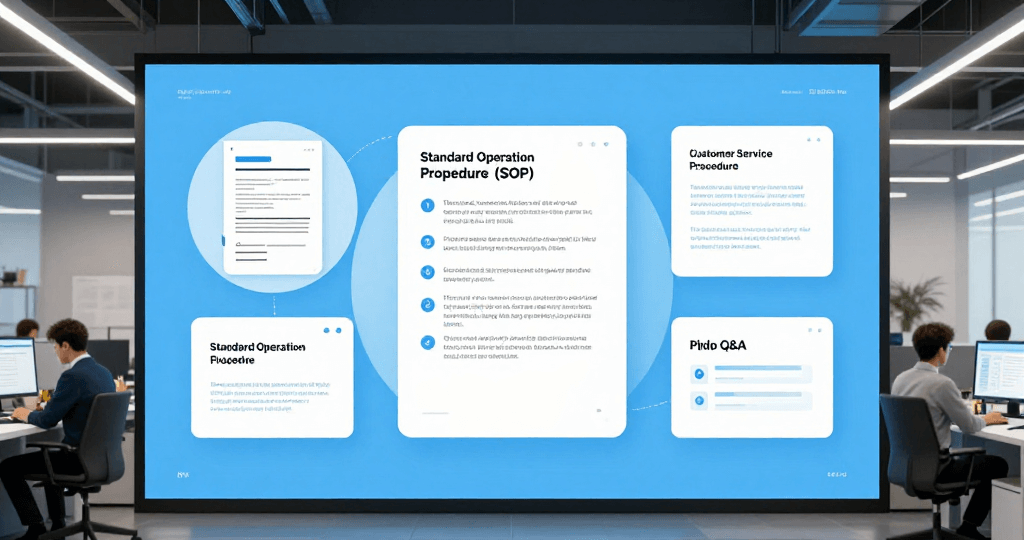
Common applications include internal document drafting, standard operating procedure (SOP) generation, customer service response assistance, initial marketing copy drafting, internal knowledge Q&A systems, and management report summaries. These truly mature generative AI applications share the common characteristics of not directly influencing final decisions, but significantly reducing upfront time costs, minimizing manpower burden, and allowing experience to be replicated and amplified.
For Hong Kong businesses, generative AI is particularly well-suited for multilingual environments, such as bilingual (Chinese and English) document processing, cross-departmental information organization, and rapid retrieval and interpretation of regulations or internal policies. Through well-designed generative AI solutions, businesses can improve overall operational efficiency without altering their existing core systems.
Many businesses, when initially trying generative AI, choose to directly use commercially available tools, hoping for quick results. However, significant limitations arise in actual use. Common problems include: generated content not matching actual business processes, inaccurate answers, inability to trace data sources, and even the risk of data leakage. In the Hong Kong market, businesses need to prioritize data privacy and internal information control, issues that general-purpose tools cannot address on their own.
These problems are not inherent to AI itself, but rather stem from a lack of "enterprise-level design." First, generic models fail to understand internal enterprise knowledge and systems, leading to responses that easily deviate from reality. Second, insufficient data security and access control make enterprises hesitant to use them with confidence. Third, the inability to integrate AI with existing systems results in fragmented workflows, increasing burdens.
Therefore, for generative AI to truly become a long-term viable capability for enterprises, it must be deeply integrated with the enterprise's data structure, access management, and business logic, and a customizable, monitorable, and adjustable operational mechanism must be built.
The core of enterprise-level generative AI solutions is integrating generative AI into the enterprise's existing system architecture, enabling AI to understand the enterprise, integrate into processes, be governable, and grow. By integrating internal enterprise data, embedding it into existing systems, and establishing clear access and auditing mechanisms, AI can become a long-term usable productivity tool. These solutions go beyond simply importing models; they establish a complete application architecture to ensure that AI outputs are trustworthy, manageable, and can continuously expand with the enterprise's development.
Based on GTS's practical experience, enterprises typically begin implementing generative AI in specific business scenarios, such as internal knowledge management or customer service assistance, gradually building dedicated AI application modules. Through customized AI multimodal large-scale model application development, enterprises can plan generative content that conforms to internal standards, while maintaining the flexibility to expand to more departments and processes in the future, making AI an integral part of the enterprise's long-term digital capabilities.
Generative AI can bring more than just efficiency improvements to enterprises; it offers an opportunity to rethink how we work. Through planned implementation, clear application positioning, and customized enterprise-level architecture design, generative AI can transform from a tool into a long-term capability supporting business growth. For enterprises hoping to steadily advance AI applications, this is undoubtedly a crucial step towards the digital transformation stage.
This article, "What Can Generative AI Do for Enterprises? Common Applications Explained" was compiled and published by GTS Enterprise Systems and Software Development Service Provider. For reprint permission, please indicate the source and link: https://www.globaltechlimited.com/news/post-id-6