GTS News Center & Latest Updates
Your Most Professional Enterprise Systems and Software Custom Development Provider!



GTS News Center & Latest Updates
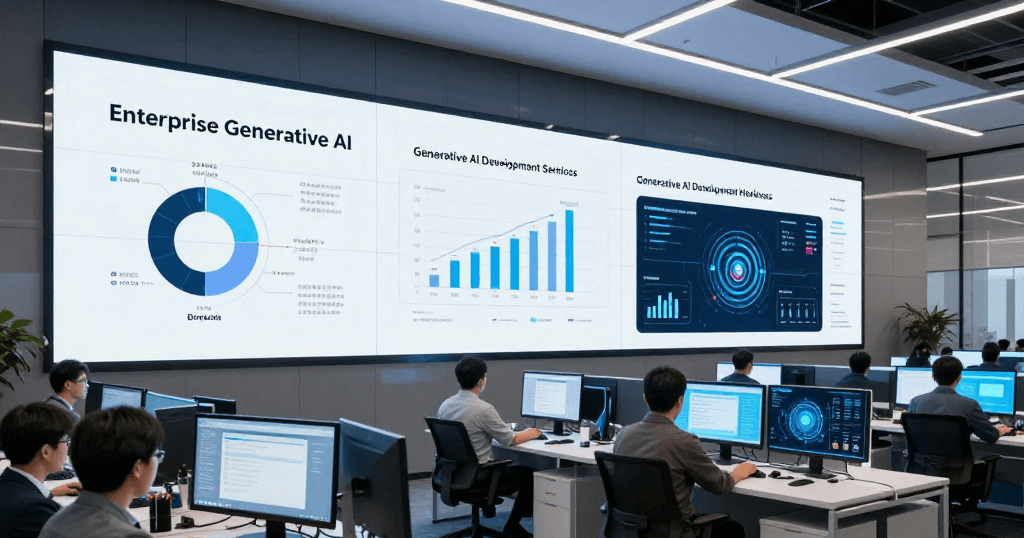
Against the backdrop of accelerating digital economic transformation, an increasing number of large enterprises and public institutions are reassessing their Generative AI Solutions strategy. From intelligent customer service and automated content generation to internal knowledge management and decision-support systems, Generative AI is steadily penetrating core enterprise processes. However, when organizations move from pilot testing to large-scale deployment, a more critical question emerges: Should an enterprise build its own large model platform? And how should decision-makers determine whether a multimodal architecture is necessary? This article examines the issue from the perspective of enterprise technology governance and architectural strategy, breaking down selection logic and practical implementation pathways to help management build long-term AI capabilities under controlled risk. In the early stages of adopting generative AI, many organizations rely on public cloud APIs or general-purpose tools to conduct proof-of-concept (PoC) testing. This approach enables rapid deployment and works well for isolated use cases such as translation or content drafting. However, once applications expand to cross-department collaboration, sensitive data processing, and internal system integration, several challenges surface: Can data be securely stored within a private environment? Can model responses accurately integrate proprietary knowledge bases? Can workflows be customized to departmental requirements? Does the system offer sustainable scalability? These concerns represent the turning point from being a tool user to becoming a platform builder. Long-term value-driven Generative AI Solutions are typically built on controllable, scalable, and governance-ready enterprise architecture. Enterprise-level deployment is not merely about API integration—it requires a complete technical infrastructure. A mature AI large model platform should include the following components: 1.Foundation Model Layer (LLM & Multi-Model Strategy): This includes Large Language Models (LLMs), fine-tuning mechanisms, and multi-model orchestration strategies to ensure accuracy and stability across different scenarios. 2.Knowledge Base & RAG Architecture: Through Retrieval-Augmented Generation (RAG), enterprises integrate internal documentation, policy materials, and historical cases to enhance contextual accuracy. This also involves enterprise knowledge base integration and strong data governance capability. 3.Agent & Workflow Layer: Enterprise-grade AI Agents can integrate with CRM, ERP, or internal management systems to enable workflow automation, going beyond single-turn conversational interactions. 4.Security & Compliance Mechanisms: This includes on-premise AI deployment, access control management, and data compliance frameworks to meet Hong Kong and cross-border regulatory standards. In recent years, AIGC multimodal large model solutions have gained significant market attention. Multimodal AI integrates text, image, and voice inputs to enhance customer engagement and analytical capabilities. But does every enterprise need it? GTS recommends evaluating based on three criteria: Are your data types diverse? If your operations involve image approval, voice records, or visual analysis, multimodal architecture offers advantages. Do business processes require cross-media handling? For example, insurance claims, financial approvals, or retail customer service. Is search accuracy a core competitive factor? Combining proprietary AI search engines with RAG systems can significantly improve content matching precision. If these needs are evident, multimodal platforms will become part of long-term competitiveness. If business operations are primarily text-based, a phased upgrade approach may be more appropriate. In practical implementation, most enterprises move through three stages: Stage 1 – Experimentation & Validation: Use public APIs or SaaS tools for isolated scenario testing. Stage 2 – Process Integration: Integrate with internal systems, build knowledge bases, and deploy foundational AI Agents. Stage 3 – Platformization: Establish a dedicated large model platform supporting multi-model collaboration, private deployment, and continuous optimization. As discussed in our article “Enterprise Generative AI Solutions: From General-Purpose Tools to Deeply Customized Workflows”, standardized tools cannot sustain long-term strategic development. Ultimately, enterprises require customized architecture to improve control and efficiency. When choosing an enterprise AI platform or implementation partner, consider: Scalability & Model Flexibility: Does it support multi-model integration and dynamic upgrades? Data Security & Compliance: Does it enable private deployment and hierarchical access control? Knowledge Base Update Efficiency: Can the RAG system synchronize internal data in real time? Agent Collaboration Capability: Does it support cross-system workflow automation design? Continuous Optimization & Monitoring: Does it provide bias correction, model monitoring, and performance analytics? These criteria help enterprises avoid costly migration risks caused by poor platform selection. Future enterprise competition will no longer revolve around isolated AI applications, but around comprehensive AI architectural capability. Mature Generative AI Solutions must combine platform governance, model lifecycle management, and multimodal integration to continuously create value in complex market environments. As a local B2B software system development provider, GTS specializes in enterprise AI customization, including proprietary AI Agents, RAG knowledge architectures, multi-model integration, and private deployment strategies. We help large organizations build sustainable AI core systems. Rather than chasing short-term tool advantages, enterprises should invest in their own digital infrastructure. If you are evaluating an AI architecture upgrade or assessing enterprise deployment feasibility, we invite you to schedule a technical consultation. Our expert team will provide architecture recommendations and an implementation roadmap tailored to your industry and compliance requirements—helping you advance AI transformation with confidence and risk control.
1. From Application Hype to Architectural Thinking: The Real Decision Dilemma
2. What Defines an Enterprise AI Architecture? Core Capability Breakdown
3. Is Multimodal Necessary? Three Criteria to Evaluate Timing

4. From Generic Tools to Platform Upgrade: A Three-Stage Enterprise Path
5. Platform Selection: Five Key Evaluation Metrics
6. Conclusion: Platformization Is the Long-Term Direction of Generative AI