GTS News Center & Latest Updates
Your Most Professional Enterprise Systems and Software Custom Development Provider!



GTS News Center & Latest Updates
Over the past year, in our conversations with senior management teams across many Hong Kong enterprises, we have repeatedly heard a similar concern: “AI is everywhere, and we have tried a number of tools, but why does it still feel disconnected from our core operations and decision-making?”Some organizations have deployed chatbots, while others have experimented with generative AI for content creation. Yet in practice, AI often remains distant from the core business.
The issue is rarely about whether AI technology is advanced enough. More often, it comes down to whether AI is planned from the outset as an enterprise-level capability. This is the fundamental difference between Enterprise AI Solutions and fragmented AI tools.
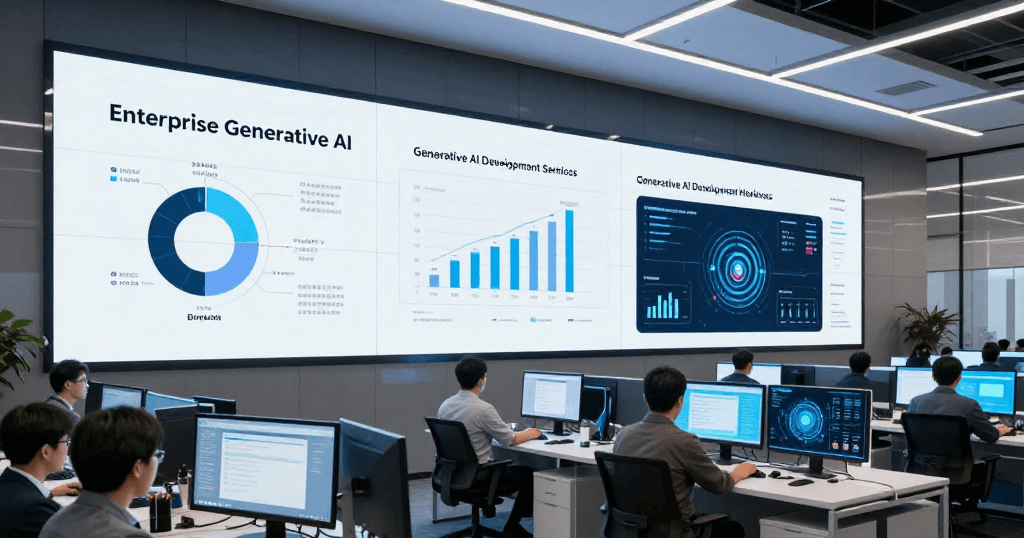
1. Why Do Enterprises Need More Than “AI Tools” — But a Complete Enterprise AI Solution?
From a product and implementation perspective, most enterprises begin their AI journey with pilot projects in a single department or scenario, such as customer service responses, automated translation, or document summarization. While these initiatives can deliver localized efficiency gains, they quickly encounter limitations:
AI operates in isolation and cannot integrate deeply with internal systems
Data sources are fragmented, making outputs difficult for business teams to trust
AI cannot be embedded into existing workflows, let alone scaled
When AI cannot truly enter operational workflows, it remains a tool for “demonstrating value” rather than one that “creates value.” This is why more enterprises are re-evaluating the overall architecture of Enterprise AI Solutions, instead of relying on isolated deployments.
There is no shortage of off-the-shelf AI products on the market. However, when enterprises attempt real-world implementation, they often discover that “easy to use” does not necessarily mean “fit for purpose.”The true value of Customized AI Solutions does not lie in technical complexity, but in how closely the solution aligns with an enterprise’s actual operating model.
Based on practical experience, enterprise-grade customized AI solutions typically share three defining characteristics:
1.Data-level customization: Understanding internal data structures, domain-specific terminology, and historical context
2.Process-level integration: AI not only answers questions but can trigger, participate in, or even drive workflows
3.Governance and access control: Ensuring data security, clear accountability, and long-term operational sustainability
Only when AI is treated as part of the system—rather than an external add-on—can enterprises meaningfully amplify their return on investment.
Many enterprises still associate generative AI primarily with copywriting, translation, or conversational tools. In real enterprise environments, however, the impact of generative AI solutions extends far beyond these use cases.
When generative AI is deeply embedded into enterprise systems, it can function as:
A cross-department knowledge integration engine: Aggregating information dispersed across multiple systems in real time
A decision-support role: Helping management quickly identify priorities and emerging trends
A workflow automation trigger: Initiating downstream actions based on semantic understanding and predefined rules
The critical factor is not whether the model is the newest, but whether AI can truly “understand the enterprise context” and operate at the right points within the organization.
If you would like a more concrete overview of generative AI use cases and maturity levels across enterprise scenarios, you may refer to our earlier article: “What Can Generative AI Do for Enterprises? Common Applications Explained.”
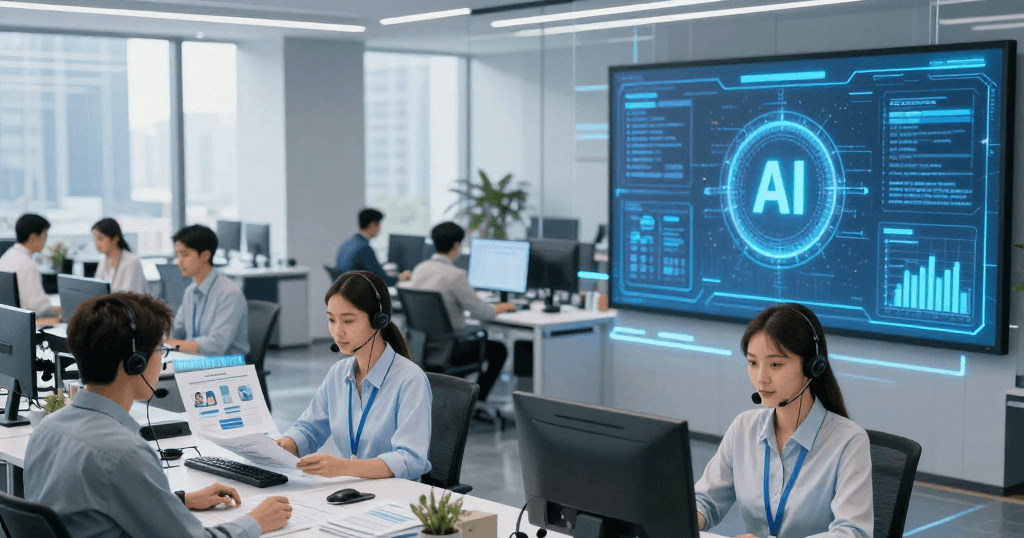
When evaluating AI initiatives, we often remind enterprises of one principle: models are not the core—architecture is.
Sustainable enterprise AI solutions typically demonstrate the following capabilities:
Multi-model orchestration: Flexibly combining GPT-series models, DeepSeek, and other leading models based on specific scenarios
AI agents and workflow design: Enabling AI not only to respond, but also to execute tasks
Data governance and security mechanisms: Ensuring compliance, traceability, and auditability
Scalable system architecture: Supporting future expansion across departments and use cases
From the perspective of product and engineering teams, we generally recommend a phased approach to AI adoption:
(1)Clearly define business problems and objectives—avoid “AI for AI’s sake”
(2)Design the overall AI architecture before rushing into development
(3)Select appropriate models and technical combinations—multi-model strategies reduce risk
(4)Introduce AI agents and workflow integration so AI truly participates in operations
(5)Continuously optimize and expand AI as a long-term capability
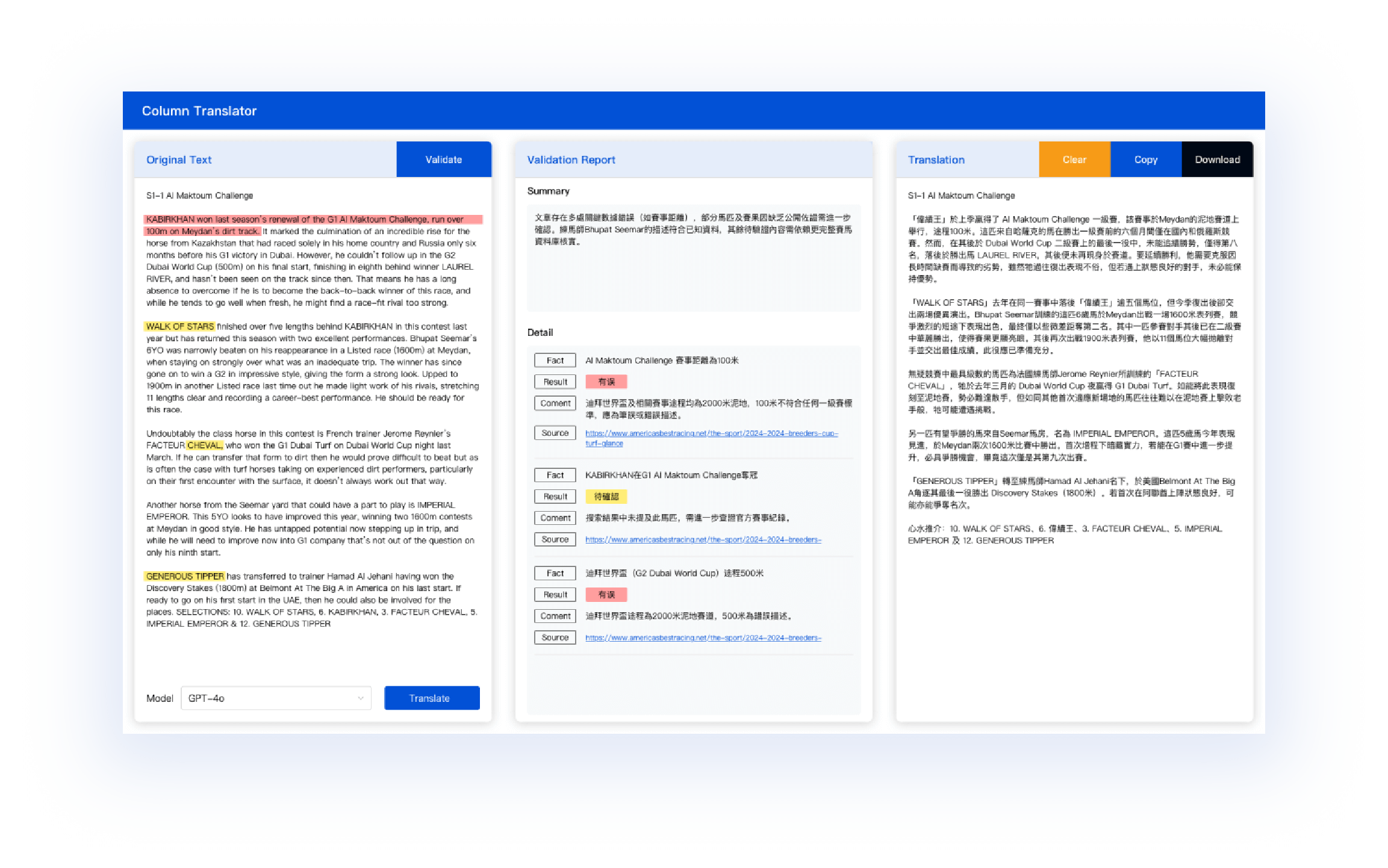
One example comes from a Hong Kong-based nonprofit organization previously served by GTS. The organization faced a sustained demand for multilingual content translation and had long relied on manual processes, resulting in limited efficiency and consistency.
Rather than deploying a single model, GTS designed a multi-model architecture combining OpenAI GPT-5, DeepSeek-V3, and other models, together with proprietary AI agents and a knowledge retrieval mechanism. This resulted in a continuously evolving translation system. Through domain-specific terminology mapping, tone and style customization, and local language optimization, the system not only improved translation quality but also automatically identified potential errors—allowing AI to become a reliable operational support tool.
Such cases demonstrate that the real value of enterprise-grade generative AI solutions lies in deep integration, not technical showmanship.
From a long-term perspective, Enterprise AI Solutions represent a foundational capability that supports enterprise competitiveness for years to come, rather than a one-off project.
If your organization is considering how to evolve AI from a tool into a true operational engine, clarifying architecture and integration strategies early will be critical to avoiding costly detours.
We invite you to learn more about GTS’s enterprise AI application and system customization services, or submit your requirements to schedule a dedicated AI architecture consultation and jointly define the most suitable AI roadmap for your business.
This article, "Enterprise AI Solutions: How Can Generative AI Truly Drive Business Innovation?" was compiled and published by GTS Enterprise Systems and Software Development Service Provider. For reprint permission, please indicate the source and link: https://www.globaltechlimited.com/news/post-id-20/